

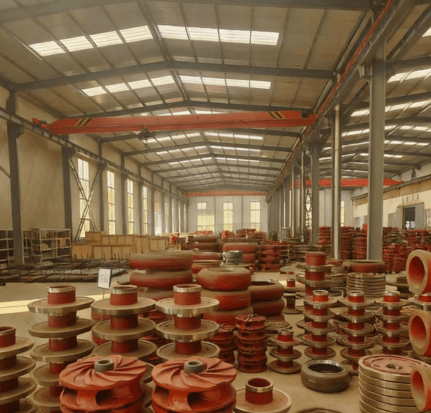
Interchangeable Spare Parts
· Standard Part Codes Covered: Fully supports all standard codes (such as impellers C2127, D3147, E4147, F6147, throatbushes, and volutes).
· Premium Metallurgy: Cast from ultra-hard high-chromium alloys (A05, A49, Cr27) with a guaranteed hardness of ≥ HRC 60.
· Downtime Reduction: Massive stock of high-demand replacement codes ready for rapid dispatch to minimize your site's operational downtime.
Interchangeable Spare Parts
The Ultimate Slurry Pump Material Selection Guide
A Complete Technical Handbook on Metal Alloys, Elastomers, and Advanced Ceramics for Mine Operators.
Part 1: Metal Wear Alloys (The Complete “A” Series)
Slurry pump metal materials are categorized into three main blocks: wear-resistant white cast irons (high-chrome), corrosion-resistant duplex stainless steels, and standard structural/ductile steels.
- High-Chromium White Cast Irons — Engineered for High Abrasion & Medium-to-High Impact
| Warman® Code (Vflu Std) |
Core Chemical Composition | Hardness (HRC) |
International Equivalents (ASTM / GB) |
Core Applications & Engineering Limitations |
| A05 (Industry Std) |
27% Cr (Chromium) 1.5% Mo (Molybdenum) |
60 – 62 | ASTM A532 Class III Type A GB KmTBCr26 |
The absolute standard for global mineral processing plants. Elite wear resistance for neutral to alkaline erosive slurries (pH 5–12). Vulnerable to strong acids and severe crushing impacts from oversized boulders (>15mm). |
| A07 (Ultra-Hard) |
15% Cr (Chromium) 3% Mo (Molybdenum) |
62 – 65 | ASTM A532 Class II Type B GB KmTBCr15Mo3 |
Extremely hard yet brittle. High molybdenum content ensures exceptionally fine grains. Tailored for handling highly abrasive, ultra-fine ores (e.g., phosphate matrix) with zero major impact. Do not use with coarse, jagged rock. |
| A49 (Acid-Resistant) |
28% Cr (Chromium) Low C (Carbon) |
56 – 58 | ASTM A532 Class III (Mod) GB KmTBCr30 |
The ultimate dual-benefit alloy for acid and wear (pH 4–12). Extensively used in Flue Gas Desulfurization (FGD), phosphate chemical processing, and mildly acidic copper/gold tailings circuits. |
| A03 (Toughness) |
Nickel-Chromium (Ni-Hard) |
50 – 55 | ASTM A532 Class I Type A | An older legacy alloy. Provides slightly better impact toughness than A05 but lags significantly behind in abrasive wear life. Mostly obsolete, except when strictly specified by legacy site blueprints. |
| A12 (Large Castings) |
Modified Hi-Cr Low Carbon Alloy |
58 – 62 | Manufacturer Specific | Exclusively developed for casting massive, heavy-duty slurry pump volutes (e.g., sizes above 450mm). Optimized foundry fluidity ensures large, thick-walled castings stay free from internal micro-cracks. |
- Stainless & Duplex Steels — Engineered for Strong Corrosion & Weak Abrasion
When the fluid chemistry drops to aggressive acid levels (pH < 3) or carries high chloride concentrations (e.g., seawater dredging), high-chrome irons corrode and rust out rapidly. Under these conditions, hardness must be traded for chemical stability via stainless steels.
| Warman® Code (Vflu Std) |
Core Chemical Composition | Hardness (HRC) |
International Equivalents (ASTM / GB) |
Core Applications & Engineering Limitations |
| A33 (Duplex SS) |
25% Cr (Chromium) 5% Ni (Nickel) + Mo |
35 – 40 | ASTM A890 Grade 1A (CD4MCu) GB Cr25Ni5Mo3N |
Premium duplex stainless steel. Offers outstanding resistance to intergranular corrosion and stress corrosion cracking, especially in high-chloride marine environments. Perfect for acidic mine water and seawater sand reclamation. Low hardness limits heavy particle usage. |
| A51 (Austenitic SS) |
18% Cr (Chromium) 9% Ni (Nickel) |
20 – 25 | ASTM A743 Grade CF8 (SS304) GB 06Cr19Ni10 |
Severe chemical corrosion environments. Extremely soft material; strictly limited to strong chemical acids carrying zero solids or trace amounts of ultra-fine, non-abrasive soft silt. |
| A61 (Super Duplex) |
25% Cr-Ni-Mo-N (PREN > 40) |
38 – 43 | ASTM A890 Grade 5A (Alloy 2507) GB 00Cr25Ni7Mo4N |
Super duplex steel. Delivers exceptional corrosion protection in highly aggressive, hot, acidic, and high-brine environments. Provides slightly better mechanical wear life than standard A33 duplex. |
III. Structural & Support Steels — Non-Wet-End Structural Components
These materials are never utilized as wet-end过流件, but form the backbone cage of the pump setup, providing structural integrity and high-pressure safety:
- A21 (Cast Carbon Steel): Equivalent to ASTM A216 WCB. Used for heavy-duty outer pressure casings. It handles extreme internal hydraulic spikes without shattering (high-chrome iron is far too brittle to act as a structural pressure shell).
- A01 / A45 (Ductile Iron): Equivalent to ASTM A536 Grade 65-45-12. Standard for medium-to-light duty outer casings, offering excellent mechanical pressure handling at an optimal cost.
- EN8 / 45# Steel: Premium carbon steel utilized to machine the pump shaft, delivering high torsional strength to handle heavy motor torques.
Part 2: Non-Metal Elastomers (The Complete “R, U, S” Series)
Elastomeric options are split into natural rubbers (R-series), polyurethane (U-series), and specialized synthetic rubbers (S-series).
- Natural Rubbers & Polyurethane Systems
| Warman® Code (Vflu Std) |
Material Class | International Standards | Core Applications & “Avoid-These-Pits” Maintenance Guide |
| R55 (Black Rubber) |
Premium Wear-Resistant Natural Rubber | Industry Standard R55 | The primary non-metal workforce. For fine slurries under 5mm (e.g., quartz sand, fine tailings), its service life vastly outperforms metal by absorbing and bouncing particles. ❌ Avoid these pits: Do not use with sharp, jagged rocks; cannot exceed 70°C; breaks down rapidly in oils/hydrocarbons. |
| R26 / R33 (Red/Soft Rubber) |
Ultra-Soft High-Elasticity Natural Rubber | Premium Soft Grade | Higher elasticity than R55. Engineered specifically for ultra-fine particle flows (e.g., cyclone overflow under 200 mesh). Deflects particles effortlessly with near-zero abrasive wear. |
| U01 (Polyurethane) |
Cast-Molded Polyurethane | Premium Polyurethane | Incredible structural tear resistance. When handling fine sand contaminated with occasional sharp debris that would slit rubber, U01 stands tough. ❌ Avoid these pits: Highly heat-sensitive; water temps over 55°C cause rapid hydrolysis and collapse. |
- Synthetic Rubbers (S-Series) — Engineering to Overcome Natural Rubber’s Flaws
Standard natural rubber (R55) softens and degrades like bubble gum when exposed to lubricants, diesel, or elevated heat. The S-Series is engineered specifically to fill these gaps:
| Warman® Code | Material Class & Abbreviation | Core Applications & Specialized Resistances |
| S12 | Nitrile Rubber (NBR) |
Maximum Oil Protection: Perfect for handling slurries laden with flotation agents, kerosene, diesel, or mineral oils (highly common in oilfield drilling muds and solvent extraction plants). |
| S21 | Neoprene (CR) |
Weathering & Mild Chemical Duty: Excellent resistance to ozone, atmospheric aging, mild acids/alkalis, with respectable mechanical wear resistance. |
| S31 | EPDM Rubber | High-Temperature Acid King: While natural rubber fails at 70°C, S31 reliably handles aggressive chemical acids up to 120°C. |
| S42 | Viton (FKM) |
Ultimate Chemical Shield: Rated up to 200°C and immune to almost all concentrated acids, organic solvents, and corrosive chemicals. High cost—reserved for critical chemical or aerospace loops. |
Part 3: Advanced Ceramics (The 3rd-Gen Material King)
In combined ‘Extreme Corrosion + Aggressive Abrasion’ setups (such as coal-fired FGD loops where sharp gypsum crystals are whirled in hot sulfuric acid and chlorides), both metal A49 and rubber R55 liners wear out in months. Advanced engineering ceramics provide the ultimate solution here.
A80 (Silicon Carbide Ceramic / SiC):
- Hardness: Mohs hardness hits 9.5 (just below Diamond, completely eclipsing all metallurgical alloys).
- Chemical Range: Total chemical immunity across the entire pH spectrum (pH 0–14). Outlasts high-chrome alloys by 5 to 10 times in fine, highly corrosive slurry environments.
- Hybrid Structure: Because solid ceramics are brittle under mechanical shock, industrial pumps deploy a ‘Resin/Metal Outer Casing + Bonded SiC Ceramic Inner Liner’ dual-layer architecture. This shield protects the ceramic from external mechanical impacts while utilizing its extreme face hardness inside.